Showing posts with label dog training. Show all posts

Tuesday, October 27, 2020

Halloween: a few safety tips for your pet

Dog in Halloween outfit


With Halloween quickly approaching, I just wanted to highlight some safety tips for our pets:

Bring your pets indoors—even if your pet is used to being outdoors, bring your cats and dogs indoors. Unfortunately, animals can be the target of pranks and teasing during Halloween, especially black cats.

Keep your pet in a safe room —little children and energetic teenagers dressed up as goblins, pirates, scarecrows or the Grim Reaper may be a bit too much for our furry friends, especially if they are on the fearful side. Sometimes, it is best to have our pets in a safe room (covered crate, a gated-off area or a back bedroom) with a stuffed Kong or bully stick. With the door constantly opening and closing, we want to make sure our pets do not accidentally run out the door.  So, keeping them in a safe room will prevent accidental escapes.

Make sure your dog has an I.D. tag and is microchipped - during the holidays is when a lot of lost pets are turned into shelters.  Pets can accidentally run out of the door either because of fear or someone carelessly leaving the door open.  Microchipping has saved many pets lives and resulted in many happy returns. 

Make sure your dog knows how to "wait" behind the door or keep your dog on a leash - If your dog is going to be loose in your home (I prefer using a safe room), make sure he/she understands the cue for “waiting” behind the door and can handle seeing people in costumes. Keep your dog on a leash to prevent darting out the door. If he/she shows any signs of stress, anxiety, or aggression, put your dog in a safe room.  Pet gates are another good option. 

Keep your pet at home—Although it is tempting to have your dog go trick or treating with the kids, with so many strange looking people out and about, it can scare your dog. Your dog may panic and get loose or react negatively and nip a costumed stranger trying to pet him/her.

Go on Candy Patrol—often the day after Halloween, I find candy and cellophane wrappers on my porch and front yard. Make sure you check your home and front yard for stray candy so that your pet does not accidentally swallow it. Raisins and chocolate can be toxic to dogs as well as the artificial sweetener, xylitol found in chewing gum and other sugarless candies.

Beware of Jack-O-Lanterns & Candles—sometimes our pets are a little clueless about fire. Happy dogs with big wagging tails or cats jumping on a table can knock over a candle.   Also young animals may be overly curious and burn themselves.  Keeping your dog in a safe room can prevent these mishaps.

Some dogs hate costumes—while cute, some dogs are not very tolerant of costumes and can get cranky and snappy. If your dog looks stressed, unhappy or uncomfortable, take it off.  Here is a primer on dog body language so that you can identify the more common canine stress signals.  


Dog wearing bandana

A bandana is as much as my dog can handle. A costume would put her in a very foul mood.

Sunday, April 5, 2020

Sheltering in Place with your pet - keeping you and your pet engaged during the Coronavirus epidemic


During this pandemic sheltering in our homes has become a way of life. Being cooped up in the house can be challenging for both you and your pet.
Fear not, this just changes the activities that you and your pet can engage in.  Here are some examples:

Walking your dog - in cities where it is permitted, you can keep up with your daily neighborhood walks.* Don't forget to wear your face mask and maintain at least 6 feet for social distancing. If you are unsure, consult with your mayor's or governor's websites regarding local guidelines for sheltering in place during this pandemic to make sure walking in your neighborhood is permitted. 

*If you are a senior citizen or in an "at-risk" or "vulnerable" group, please make sure you follow your doctor's orders and/or city or state's guidelines regarding staying at home.  Walking in the neighborhood may not be an option for you if you are at-risk.  

Training – why not use this time in the house to reinforce some of your dog’s training? Put together a series of behaviors for your dog to perform and reward your dog for the last behavior in the chain. Go to your spot, lie down and stay is an example of a training combination. Or teach your dog a new trick. YouTube and other websites have videos of how to teach your dog to do simple tricks.  Just remember to change the order and combinations of your tricks so your dog does not begin to memorize the order or sequence of tricks.

My YouTube Channel has some videos you can refer to for training dogs, cats and even birds.

Hide and Seek – playing hide and seek games where your dog has to find you in different parts of the house is a great way to reinforce your dog’s recall (coming to you).  When training a dog to come when called, always remember that when they find you to reward them with effusive praise, petting and/or treats. Teach them that finding you is a big party.

Toys
Some toys can be used when the dog is left alone or for times when you need to keep your dog occupied (e.g.when you are on a call, you are busy at the computer, when you are having a meal). These toys must be fairly indestructible and have no small parts. Most people have Kong toys but there are many others you can order online or obtain from most pet stores.

Kongs (http://www.kongcompany.com) are great toys that can be stuffed with your dog's kibble, treats, and other foods. Your dog will spend a lot of time trying to get the contents out of the Kong. Think of it like a doggie pacifier. For heavy chewers the Extreme Kong (black version)would be a better choice. The Kong website has instructions on how to use it with recipes and I also posted a blog about the many uses of Kongs which you can read about here.

One of my favorite ways to use a Kong is to hide one or more Kongs around the house (I like to use places other than the kitchen or dining room) and ask your dog to find it. My dogs have been taught that the word “find it” means go hunt for the object. An empty Kong makes a great fetch toy as well.


Tug a Jug - This toy, made by Petsafe Pet Products, requires the dog to manipulate the jug and rope to try to get the treats out. If you use smaller treats, it is easier for the dog to get the treats. If the rope is destroyed, you can place balls in the jug for continued play. The other nice thing about this toy is that the jug is see-through so the dogs can see the treats inside. This toy has a high difficulty rating in my book so it may be too difficult for inexperienced dogs like puppies.
Here is a video of my two year old Akita, Kiku, who takes a patient and systematic approach to problem solving:


Twist and Treat – this is another similar rubber toy called the Twist and Treat is made by PetSafe. This toy is probably better for smaller dogs and less powerful chewers. This toy has the advantage of being adjustable depending on the size threat you are using so I find it easier for most dogs.


Buster Cube -  The Buster Cube has been on the market a long time. This was one of the original toys I used with my 10 year old Shiba Inu when she was a puppy. The Buster Cube dispenses dry treats randomly when the dog moves the toy around. You can also adjust the level of difficulty depending on the skills of your dog.


Kibble Nibble: This is another Premier toy similar to the Buster Cube. The object of the game is to roll the ball around to make the kibble come out.The ball is see-through and the dog can see how much kibble is left. It takes some experimentation to determine what size kibble/treat works best so that it is not too easy or too hard.

Here is video of my Shiba Inu, Mitsu, playing with the ball. She is almost 11 years old now and she is going after the ball with gusto. This video is not sped up, this old gal is actually this frenetic. She ended up playing with this ball for about 15 minutes, did a couple of shiba yells at the ball, got a drink of water and came back for another 10 minutes before I took it away from her. During the video you can see a treat flying out of the ball:


Toys Requiring Owner's Participation


This category of toys are toys that involve the participation and supervision of the owner. Examples of traditional toys requiring owner participation are balls, fetch toys, tug of war toys and frisbees. There are also toys that involve problem solving skills. Nina Ottoson has created a whole line of toys which help hone your dog's problem-solving skills and at the same time help develop the bond with your dog. These toys require human supervision and they must not be left alone with your dog because of the moving parts and materials that can be chewed up into small pieces if unsupervised.

The Dog Brick - this toy requires the dog to remove the bricks and slide the covers to get to the treats. The link provided contains an instructional video on how to use this toy. Below is a video I made showing how my dog solved the brick.


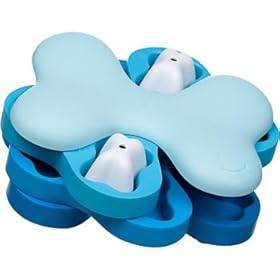
Dog Tornado: This toy has a higher difficulty rating than the Dog Brick and it is definitly more challenging. What is fun about this toy is that you can potentially put your dog's entire meal (especially for small dogs) in the Tornado thereby slowing down their eating and preventing gulping their food. Again, these toys require your supervision because there are small parts.


Here is a video of my female akita, who is a little more sophisticated at solving puzzles, using the Tornado at a more advanced setting to make it more difficult to have access to the treats:


Cat Training and Toys

And some of these toys are not limited to use for dogs. Even cats can get in on the fun. Here is my cat using the Dog Tornado as a way to keep her occupied and to prevent her from gulping down food too fast.  


You can even train your cat to dog the same tricks as your dog!


For more videos on training you can go to my YouTube channel.


Take advantage of this time at home to bond with your pet and most of all, stay safe everyone!

Wednesday, January 9, 2019

January is Train Your Dog Month

Happy New Year! January is Train Your Dog Month. In 2010, the APDT began the National Train Your Dog Month to promote the importance and benefits of Dog Training so that our dogs can be happy and healthy companions. According to the APDT “too many dogs are turned into animal shelters each year for behavior and training issues that could be easily solved with proper socialization and positive, gentle, science-based methods of training.”  Addressing behavioral issues early on and being proactive can help prevent these behaviors from turning into serious problems. In honor of Train Your Dog Month here are some dog training tips and resources:


1) Puppy Socialization: for those of you who have or are getting a puppy, socialization is one of the most important things you can do to give your puppy a head start. Socialization should start early. Even if your puppy does not have all his/her shots, you can have people come visit your home. Once your veterinarian clears your puppy for walks around the neighborhood, you can get your puppy used to the sights and sounds of a city for example. Brief car trips (to minimize motion sickness) where the puppy can stay in the car and watch people walk by is also helpful.  You don't want your puppy's early car trips to be just vet visits as this can set up a negative association. So short, fun excursions are important for early socialization.  Go slow, try not to bombard your puppy with too much at once. We want these experiences to be positive! Enrolling your dog in a well-managed puppy class that uses positive and gentle methods is one of the best ways for your puppy to get exposure to people and other dogs in a safe, controlled environment. For an explanation of why socialization is so important, here is a position paper written by the American Veterinary Society of Animal Behavior: AVSAB Puppy Socialization Paper

I cannot stress enough how important puppy classes are.  Many dogs who are surrendered at shelter in rescues did not receive adequate training or socialization during the critical period in their puppy hood.  Training classes can nip a lot of potential problem behaviors in the bud and head off more serious behavioral issues in the future.  

Here are a few of my favorite puppy books:


2) Rescues and Older Adoptees – many people choose to adopt older rescues. The issues rescues face are different from puppies. While rescues have outgrown many of their puppy behaviors such as play biting and destructive chewing, they may not be house trained and may have fear or anxiety issues from being in a shelter, abandonment or other stressful experiences. It is important to be patient and work through these issues at your dog’s own pace. Respect your dog’s comfort zone and work at the speed your dog can handle. Pushing your dog too far too fast can trigger fear issues and set your training backwards a few steps. If your dog is ready for group classes, then that is a good start. If your dog is very fearful or reactive, then private training may be a better first step. A great book that deals with the unique issues that rescue dogs face is Pat Miller’s “Do Over Dogs: Give Your Dog a Second Chance for a First Class Life.”


3) Maintain Realistic Expectations About Your Dog – besides respecting your dog’s comfort zone it is also important to be realistic about your dog’s abilities and personality. Some dogs may never be the social butterfly you want them to be and are in reality a homebody that prefers human companionship. Shy, older dogs may not enjoy dog parks and in the case of some middle-aged or senior dogs, large, group classes may be too stressful. However, that does not mean you can’t find a fun activity the two of you can do together, train in other settings or find dog friends that your dog can have one-on-one play sessions with. My Shiba Inu is not that social with other dogs now that she is an adult.  Once she reached maturity, she stopped playing with dogs at the dog park and would spend the entire time sitting with strangers at the park. It was at this point, I decided that she was no longer getting that much out of being at the dog park and instead I took her on excursions in the city or hanging out in cafes which she seemed to enjoy more. Respecting your dog's physical limitations is another factor to consider.  My big, clunky 90 pound Akita is probably not the best dog for agility training (nor would I want to subject his aging joints to this particular activity). Forcing a square peg in a round hole, is not always the best for the dog and it can lead to unnecessary frustration on the owner’s part.  Try to find activities that your dog also enjoys and work at your dog's own pace.

4) Find Fun Activities to Do With Your Dog – Training is a great way to bond with your dog, but it does not have to stop there. There are other ways to spend time with your dog such as hiking, camping or playing games. If your dog is very energetic and athletic, agility or other dog sports like flyball may be a great outlet.  Try to figure out what activities your dog really enjoys. 


To find out more information on dog sports here are some good sources: 

Agility - http://www.akc.org/events/agility/index.cfm
Rally - http://www.akc.org/events/rally/
Tracking - http://www.akc.org/events/tracking/
Flyball- http://www.flyball.org/


5) Incorporate Training into Your Daily Routine – many of the things you learn in group class have practical applications in real life and should not end once the class is over. For example, “stay” or “wait” can apply to boundaries such as the front door or the curb and help teach your dog not to run out in traffic. Having your dog go to their bed or place is helpful when guests come to the home or when the doorbell rings. Incorporating training in your daily routine helps reinforce these behaviors so that your dog will retain these skills throughout his/her life. On walks, I practice “sit,” “wait,” “stops/halt” and recalls (“come”). Having a solid recall is one of the most important things to teach your dog and should be reinforced throughout your dog’s lifetime. If your dog has not had any training go to http://www.apdt.com/ or http://www.trulydogfriendly.com/ to find a trainer or group class in your area.  

6) Keep Training Fun - I like training sessions to be short, fast-paced and fun.  Since I own Northern breeds (Shiba Inu, Akitas) that tend to bore quickly and easily, I try to keep them engaged by changing things up and keeping it interesting.  Overly long training sessions, especially for young puppies and the more independent breeds, can lead to frustration for both you and your dog. 

7) Exercise – a great New Year’s resolution is exercising with your dog. This is both beneficial for both and your dog! Exercise relieves tension and stress and stimulates your dog’s senses.


For more information on Train Your Dog Month go to:  http://www.trainyourdogmonth.com/tips/

So with this New Year why don’t you make dog training one of your New Year’s Resolutions! Wishing everyone a happy and healthy year.


Monday, July 10, 2017

Hot Weather Tips - Have You Done the Barefoot Test?


On hot summer days I often see people walking their dogs on the sidewalk and asphalt in the middle of the day.   I often cringe when I see this because the pavement can heat up significantly and because we humans wear shoes, we often don't realize how hot the pavement is.  


I often have to work with clients using my dog, Kiku, as a decoy dog and I will not schedule sessions in the middle of the day because I fear the sidewalk and black asphalt will burn her pads.  

I will often do what I call the barefoot test and put my barefoot on the asphalt to test out how hot it is. This last weekend the temperature in my neighborhood reached 88 degrees F.  I did the barefoot test on my street and I could hold my foot on the pavement for only a few seconds because it was so hot.


At 88 degrees my foot started burning after a few seconds.


Avoid Peak Heat Hours - avoid peak hours by walking your dog early in the morning and in evening.  Even then you may want to do the barefoot test because the sidewalk may still retain heat from earlier in the day.  This test applies to all hard surfaces  cement, asphalt and gravel.

Watch for signs that your dog is under distress:  limping, licking feet, whimpering, walking gingerly, trying to get to the grass, lying down in the shade.

Puppy foot pads are more delicate - if you have a puppy, their feet are more delicate because the pads have not yet developed tough callouses.  Be extra careful during the period when your puppy is in this phase.  

Check your dogs pads for cracks, blisters, bleeding or burns.  If you find any injuries, wash the wound with soap and water and take your dog to the vet for further treatment.  

Check all hard surfaces including gravel.  Here is a hot Kiku trying to get some shade

So this summer be mindful of your dog overheating and burning those cute doggy feet.  


Monday, May 19, 2014

Dog Bite Prevention

This week is Dog Bite Prevention Week and here are a few tips to minimize the risk of dog bites:

Learn a dog's stress signals

In my last blog on Canine Body Language I go over some of the common postures and stress signals that dogs exhibit.  Here are a few stress signals to be on the look out for:  frequent yawning, licking lips, ears pulled back, pacing, panting.  If your dog is stressed, do not force them to meet someone they are afraid of.  In a similar vein, learn your dog's aggressive stances.  This could include stiff body, very still body, ears forward, body leaning forward, hackles raised, tight/closed mouth, hard stare, curled lip, growling and snarling.  Here is a video showing some common stress signals:


Respect these signals and remove your dog from the situation that is causing stress by increasing the distance.  Don't worry about offending a stranger.  Your dog's well-being is more important.  If your dog is frequently afraid of strangers, work with a dog trainer or behaviorist to develop a behavior modification program to help your dog feel more at ease around strangers.  It is important to choose a professional who focuses on positive reinforcement methods.  If you meet someone else's dog exhibiting these signals when you approach them, stop and slowly back off to give the dog more space. 

Appropriate Greetings and Interactions


Besides being able to read a dog's body language or stress signals, another factor that can reduce the incidence of dog bites is knowing how to greet a dog in a manner that will put the dog at ease.  Here are a few tips:

1) Stop 5-6 feet in front of the dog.  This is usually the distance that a dog is comfortable with and is also the length of most leashes if the dog is on a walk.

2)   Ask the owner if you can pet the dog.  If the owner hesitates or says the dog is not always friendly, move on.  If you are the owner and you notice that your dog is fearful or showing stress signals, ask the person to stop moving forward and refrain from reaching towards your dog.

3)  Turn your side to the dog  - dogs are often more comfortable when your side is facing them rather than facing them head on.   By turning your side to the dog, it makes them more comfortable to approach you.

4)Let the dog approach you - rather than going towards the dog and invading their space, let them approach you.  If the dog does not want to approach you or shows you the stress signals mentioned above, then leave the dog be and do not try to pet the dog. 

5)  Pet the side of the body or neck - avoid blind spots like the top of the head. Fearful dogs do not like to be petted on top of the head and do not like people hovering over them. 
Here is a video showing the steps:


Sadly, small children under 9 years old are one of the most frequent recipients of dog bites.  Children move faster than adults and toddlers move in a manner that seems erratic and odd to dogs.  This video from Dr. Sophia Lin and illustrated by Lili Chin (the artist who did the doggie drawings on my website), really captures what a small child seems like from a dog's perspective:


This video highlights the importance of supervision and management when young children and dogs are in the same room or area. There is a tendency for young children to want to hug, kiss or grab dogs much like a stuffed animal and this runs the risk of a bite to the face. It is therefore important to teach children how to appropriately greet a dog.  Most dogs do not like to be hugged or kissed on the face and make it practice not to do this with your own dog. Be vigilant of stress signals and teach your child the appropriate way to approach and handle a dog


This dog is tolerating the hug but is shying away from close contact with the person's face. Notice the flattened ears and head tilting away from the person.  Teach your children appropriate ways to interact with a dog that helps put the dog at ease.


Runners and Bicycles

If you have a dog that reacts to fast moving objects, be vigilant and aware of oncoming runners and cyclists.  Make a point of teaching your dog to sit and stay so that you can step out of the path and give enough space to allow the person to go by.  If you have a dog, that lunges and goes after runners or cyclists, consult with a trainer to help your dog learn to handle people and bicycles moving quickly by them.   When I run or jog behind a person with a dog, I try to give them a heads up several seconds before I approach them to give them a chance to move out of the way and not surprise them.

These are a few tips to help you understand canine body language and how to approach a dog safely.

Tuesday, December 31, 2013

A Few New Year's Resolutions


Happy New Year everyone! When it comes to New Year’s Resolutions we tend to focus on ourselves. But since this is a dog training blog, I am going to focus on our dogs.  Here are a few resolutions based on my experiences with my own dogs and from helping my clients with theirs:

1) Incorporate dog training in my everyday routine – now that my “puppy” is full grown, it is very easy to let all that old puppy training fall by the wayside. So this year I will strive to reinforce my dogs’ training by continuing to incorporate them in my everyday routine. A few examples are:
• Asking my dogs to “sit” and “wait” behind the door before going for a walk so that they learn not to dash into the street.
• Asking my dogs to “sit” before I put the leash on them for a walk so that they learn to be calm before going out for a walk.
• Asking my dog to “sit” before releasing her to “take” the toy for a game of tug of war or fetch.
• Asking my dogs to “sit” and “leave it” until I am able to put the food bowl down on the floor before giving them my release cue (“o.k”) to take the food.
• Asking my dogs to “go to their beds” and “stay” while I am eating my meals.

Incorporating these simple requests to your daily routine will seem less like a chore (for both you and your dog).  In the end, you will have a well-mannered dog with relatively little effort.

2) Management – having a dog with good house manners is a combination of management and actual training. Often the management portion of this equation is overlooked. Keeping or removing food from the counter before leaving the house will reduce temptations for your dog and will help keep your dog from forming a habit of “counter-surfing.” Dogs will continue to perform behaviors that are successful for them and behaviors that do not reap any rewards gradually extinguish. So, if my dog is “rewarded” by getting a piece of food off that counter (even if relatively infrequent), there is no impetus for her to stop checking out the counter while I am out of the room. If my dog knows that food is not on that counter when I am not home, she is less likely to scavenge while I am out of sight. Management is also good way to keep your pup from destroying your favorite pair of leather shoes. Putting shoes away in your closet and closing the doors to your bedroom will prevent access into non-puppy proofed parts of the house when you are not home. Baby gates are also good management tools until your puppy passes the chewing phase and learns to chew the appropriate toys. If your puppy does not have access to shoes but instead has access to chew toys, you will protect your property. Who knew that having a puppy can lead to a clutter-free house.

3) Give my dog time to think - often we get impatient and we have a tendency to repeat the verbal cue over and over again thinking that it will make our dogs perform the behavior more quickly. If anything, it leads to your dog tuning you out. Instead, once your dog has learned the verbal cue for the behavior you are training, use the word once and give your dog time (10-15 seconds) to think about it. Repeating the cue while your dog is trying to figure out the behavior is the human equivalent of someone standing over your shoulder asking you, “what is 29x37” over and over again while you are trying to solve the equation. If your dog does not complete the task within that time frame, go back to the previous step in training (e.g. using a hand signal or lure with the verbal cue) and practice at that level until your dog becomes more proficient.

4) Exercise – regular exercise stimulates your dog not only physically but mentally. Your neighborhood is a smorgasbord of smells, sights and sounds that are different from what your dog experiences at home. A bored dog can be very destructive. When my dogs are bored, I often find little holes my backyard. Exercise can help channel some of that pent up energy.  Similarly, exercise can help with high energy and anxious dog.

5) Play more games with my dogs – playing games with your dog not only stimulates your dog mentally but it helps foster the bond with your dog. Although some dogs can play fetch until the cows come home, other dogs will get bored of this game after awhile (Northern breeds come to mind). This year I plan to introduce more games into my dogs lives beyond fetch and tug of war (which my dog never seems to get tired of). My dogs like to hunt and they love the “find it” games where they have to search for different objects to receive a treat. I also use training as a game and try to teach new tricks or combine different behaviors in a row (chaining behaviors) before the dog receives a reward. Keep training sessions short (5 -10 minute sessions at a time) to maximize on the “fun factor.”  For more information see my review of popular interactive dog toys on the market.

6) Give my dogs some down time – sometimes it is tempting to try to train your dog every day for long periods of time especially if you are working on modifying  particular behavior. I have found that it is beneficial to give my dog some down time from such intensive training because I want my dog to look forward to training rather than view it as a stressful event. Taking a day or two break can give my dog time to recoup and lessen the likelihood of burnout (for me too). Dogs need alone time too.

7) Appreciate every moment with my dogs – dog years are too short as far as we are concerned. That is why we should appreciate the time we have with our pets while they are with us. I have two senior dogs right now and I appreciate the confidence and tolerance that many older dogs have. The comfort and security that our senior pets provide is reflection of the strong bond formed after years of working together. Without my older dogs, I am sure my Akita puppy would have been a handful, but my older dogs have kept some of her rowdy teenage behavior in check. There is something to be said about the wisdom and experience of an older dog.

8) Keep expectations realistic – there is a temptation to expect too much from our pets. We have a 6 month old puppy and we expect them not to chew on our favorite chair. We expect a kitten not to climb up our drapes. We have a 10 year old dog and we expect them to adapt to new and strange situations like a younger dog. We expect an independent breed like a husky or akita to want stick to your side at all times or want to perform repetitive tasks. We adopted a dog from the shelter a few weeks ago and we expect them not to be fearful or anxious. This New Year, let’s keep our expectations realistic based on our pet’s age, history, temperament and personality. Realistic expectations reduce frustration and forge a better bond with your pet!

9)  Nip those behavioral problems in the bud - sometimes it is easy to ignore some of your dog's behavioral problems.  For example, we let the dog jump on us because we think it is cute or affectionate but let it go on and one day your dog may knock someone over.  Your dog may start guarding objects or food and let that go on and it can escalate to guarding entire locations of the house/couch or the behavior may become more pronounced.  Sometimes, I get calls from people who have had a behavioral issue that has gone on for years.  In such cases the behavior can become so ingrained that it is harder to treat.  So, if there is a behavior that you find problematic or can foresee becoming problematic, get the help you need and address it before it escalates.

10)  Go at your dog's own pace - this is a corollary to #8 above. Often when we are working with our dogs, whether it be a puppy or a dog with behavioral issues such as fear or aggression, we may have some arbitrary time table by which we have set some goal or want a problem "fixed."  Sometimes our timetables do not match up with what our dog's is able to accomplish. Trying to push our dogs faster than what they can handle can backfire or lead to frustration on our parts. For example, if you have a fearful dog, bombarding the dog with the object he/she is afraid of (person, dog, garbage truck, motorcycle etc) over a short period of time may intensity this fear and cause the dog to shut down. Often with behavioral problems it may take weeks or months to resolve and pushing your dog above and beyond what he or she is capable of will only serve to increase stress levels.  Instead, just go with the flow and appreciate the accomplishments your dog makes even if it seems like baby steps.

Do you have any New Year's resolutions for you and your pet?

Happy New Year and Happy Training!

Pawsitive Feedback Training
www.pawsitivefeedback.com

Monday, December 30, 2013

New Year's Eve Fireworks and other loud noises

In many cities, New Year's eve is celebrated with setting off fireworks (and sometimes even guns).  For the safety of your pet, keep your pet indoors on New Year's Eve.

If your pet is afraid of fireworks and other loud noises, follow this link to my earlier blog on how help your dog through the "noisier" holidays:

http://pawsitivefeedback.blogspot.com/2010/06/4th-of-july-tips-for-fireworks-fearing.html.

Wishing everyone a Happy New Year!!!

Thursday, June 27, 2013

4th of July Tips for your dog

With 4th of July just around the corner, it is important to keep your pet safe and secure.   Many dogs are afraid of fireworks.  Here are some things to keep in mind to keep your pet safe and happy this holiday:


* Avoid keeping your pet in the yard.  Fearful dogs will often try to dig, jump or climb their way out of the yard to escape the noise.  Many dogs get lost and end up in the shelter this way. 


*Make sure that your pet has proper ID in the event that he/she gets lost. Consider microchipping your dog.


*Avoid the temptation to take your dog to fireworks shows or outdoors. A fearful dog could bolt and get lost. Fearful dogs can also feel trapped and may lunge or bite people or other dogs around them. Play it safe, keep them at home.


*Keep your pets indoors and provide a secure place for your pet stay in.  This can be a crate or a quiet, pet-proofed room in your home that does not receive as much outside noise. Dogs can try to chew their way out of an area when scared so make sure it is a secure area.  Close your windows and front door to shut out outside noises.

*What if you have a new dog or puppy and this is their first 4th of July? Play with your dog. During those hours when fireworks happen (usually 9 p.m. to midnight here in Los Angeles), play games with your dog. Play fetch or tug of war. Give your dog a toy to play with or work on a Nina Ottosson interactive puzzle with your dog. Click here for examples. Interacting with you will keep your dog's mind off the noises outside and on the games you are playing with your dog. Here is an example of my dog working on Tug-a-Jug under my supervision.  She is so preoccupied with working on this toy that outside noises are unlikely to distract her:


*Consider playing music or keep the T.V. on as background noise. There are music CDs that have been created specifically to calm dogs.  Through a Dog's Ear is an example of a CD series. 


*Alternative remedies:  For mild cases, some dogs respond well to flower essences and homeopathic remedies. Bach's Rescue Remedy for pets is one of the older brands out there and can be found in most natural pet stores.  For homeopathic remedies you can consult with a homeopathic veterinarian for suggestions and dosage instructions.


*Body Wraps: many people have had success with body wraps which in effect "swaddle" your dog. I often use this product with fearful or anxious dogs. In her book, "Help for Your Fearful Dog," Nicole Wilde discusses a variety of methods of doing this and the proper way of introducing your dog to a wrap. In addition, there is a body vest marketed under the brand names, "Anxiety Wrap" and "Thundershirt" designed to achieve the same result. However, you should first acclimate your dog to the vest before a storm or fireworks so your dog does not react negatively to wearing the vest.


*Another calming product is Dog Appeasing Pheromone that can be sprayed on your dog's bedding or used as a room atomizer.  It is usually sold in pet stores under the brand name "Comfort Zone." 


*For severe cases talk to your vet:  for severe cases of anxiety or if your dog is at risk of injuring himself/herself, prescription medication may be necessary to keep your dog calm and safe. In such cases,  it is best consult with your veterinarian before the holiday.


My old akita had mild to moderate anxiety to fireworks. I made sure that he was in a pet-proofed room with the T.V. on and the windows closed. Sometimes I distracted him with toys and games he liked to play. I also used a Thundershirt and distracted him with Nina Ottosson puzzles which seemed to help:


Los Angeles Dog Training: www.pawsitivefeedback.com
Recommended Reading:


Los Angeles Dog Trainer:  http://www.pawsitivefeedback.com
'

Tuesday, June 19, 2012

How to teach your cat (or dog) to sit


Despite what most people believe, cats can be quite trainable.  My cat is clicker-trained and has picked up on almost all the same behaviors that I have taught my dogs in my group classes.  Since this is adopt-a-cat month, here is a link to the first how-to video on training your cat to sit on cue:


http://www.pawsitivefeedback.com/videos/catsit/trainingsit.swf


Los Angeles Dog Trainer:  http://www.pawsitivefeedback.com
'

Thursday, May 17, 2012

Harnesses, Martingales, Gentle Leaders, Oh My!

As a dog trainer, I feel compelled to try all the various no pull harnesses and collars on the market so that I can give an educated or (at least a first-hand opinion about how they compare). Owning two Akitas, I am fortunate enough to have dogs that are powerful and have a natural tendency to pull so they have been my guinea pigs so to speak. Here is the rundown and review of what harnesses I have tried and my personal opinion on the pros and cons of each:

Freedom Harness by Wiggles, Wags and Whiskers

This harness may be my favorite. I was introduced to this harness by Fabienne Lawrence at Bam Bam and Friends who carries this harness (I have not seen it anywhere else in Los Angeles). It is also a front-clipping harness like the easy walk but slightly different construction.


Here is Kiku wearing the Freedom Harness. The leash that comes with the harness makes it a versatile piece of equipment.

Pros: Works well on most dogs and cuts down on pulling. Like the Easy Walk, there is no breaking in period because the dog is more likely to accept this harness. The body strap is made out of velvet and softer than the Easy Walk. It comes with a lead that has a double clip and it can clip to D-rings in the front and on the back. The lead is adjustable from a 3-foot traffic lead to a 6-foot lead. The chest strap fits better than the Easy Walk (at least on my dogs).

Cons: pricier than the Easy Walk. Hard to find at pet stores (in Culver City at Bam Bam & Friends or online at Wags, Wiggles & Whiskers ).


Easy Walk Harness

Tis harness ranks high on my list of no-pull equipment.


Pros: Works well on most dogs and cuts down on pulling. No breaking in period as most dogs take to them readily, easy to use and effective on most dogs. It is easy to find at most pet stores and not that expensive.

Like the Freedom Harness, I use Easy Walks on some of the rescues I work with because of the ease of use and acceptance by the dog.

Cons: the chest strap does not fit well on dogs that do not have broad or protruding chest. In such cases, I clip the front d-ring to the neck collar with a carabiner to keep the front strap from dropping too low. The Freedom Harness tends to be a better fit with most dogs especially ones with narrow chests.


Here is Kiku wearing an Easy Walk harness which is attached to the neck collar with a carabiner to help hold it up.


Sporn Halter (with sheepskin covers)


Pros: cuts down on pulling surprisingly well (at least with my dog), no break-in period.

Cons: cumbersome to put on and take off, too many clips and moving parts (not good for furry dogs because hair can get caught), sheepskin covers slip and move too easily. Less control for reactive dogs.


Here is Kiku sporting a Sporn harness on a hike at Will Rogers State Park.

Sporn Simple Control Harness


Pros: Easier to put and take off than the Sporn halter, no break-in period.

Cons: Experienced more pull than with other harnesses.


Sporn Mesh Control Harness


Pros: Seems easier to put on and take off than the Sporn Halter. Decent job at reducing pull. No break-in period.

Cons: the mesh panel in the front did not fit well (on my dogs).

Gentle Leader

Gentle Leaders are not my first “go to” piece of equipment. But there are times when it may work better on certain dogs and for certain owners. I recently recommended a Gentle Leader for a client that had limited mobility due to a recent knee surgery and who had a very large dog. In this case, I felt the better control the Gentle Leader provided was warranted given the size of the dog and recent surgery. Sometimes, I also use this harness on a more reactive dog.


Pros: significantly cuts down on pulling, good control over the dog’s movements, a good option for reactive dogs or for people who are not that strong.

Cons: requires an adjustment period for many dogs, many dogs do not like the sensation of something over their mouth. People think the dog is wearing a muzzle and their fear of the dog will be expressed through body language and facial expressions.

However, one of the reasons, that I do not use the Gentle Leader very often, which is leading me to the “oh my” part of this piece is that, despite the fact that this product has been on the market for nearly two decades, people still mistake the nose loop for a muzzle. This causes people to recoil from the dog (especially when the dog is a large breed dog that has prick ears and looks like a wolf). When you see a golden retriever wearing a gentle leader that is one thing, but an Akita wearing a Gentle Leader causes people to side-step the poor dog and treat the dog like a pariah. For a young dog that needs to be socialized, this is not the reaction you want the dog to get from people the dog is trying to be friendly with. When my white Akita is wearing her Freedom harness, she receives smiles and requests from people to pet her. When she is wearing a GL, she receives sideways glances and people trying to avoid her. Because of this reaction, she rarely wears a GL because socialization is a high priority for this breed. So, there is a trade-off between control and managing reactivity and socialization with strangers.

Martingale collar

This is a nylon collar with a limited constriction on the neck. My Shiba Inu, who is an escape artist wears one. She does not pull so there is little pressure applied to her neck and I never jerk on her collar. This collar is better than a choke collar because the amount the collar tightens is limited and does not choke the dog if fitted properly. It is also good for dogs that have narrow heads like greyhounds or whippets.


Pros: prevents accidental slippage for dogs with narrow heads or who are escape artists.

Cons: does not necessarily cut down on pulling.

Choke chains/training collars/prong collars

Although I have used choke collars many years ago on dogs that have long since passed on, I don’t use them currently. Most people do not know how to use them properly and because of this, the risk of injury on the dog is too great. Moreover, dogs tend to pull more when pressure is applied to the neck, so I find the no-pull harnesses to be a safer and more effective way to discourage pulling. More importantly, why train dogs by putting pressure on their necks or choking them when you can use positive methods to teach them to walk on a leash. For these reasons, many trainers, including me, discourage the use of choke chains. See APDT UK's Brochure on choke collars here.


Los Angeles Dog Training
www.pawsitivefeedback.com

BlogCatalog

Tuesday, April 3, 2012

Where Sleeping Dogs May Lie

The Myth:  Many people ask me about whether it is a no-no to let your dog sleep on the couch or bed.  Often you hear the absolute rule that you should never let dogs sleep on your bed or other high place because it will make them feel "dominant "over you. 

The Reality - There are many dogs who can sleep on a bed or sofa and never show aggression towards their owners or show any other behavioral problems. The act of letting your dog sleep on the bed does not mean your dog will begin to "dominate" your or that you will lose "alpha" status.  Many of these ideas of dominance and being the alpha are questionable and it is more important to focus on the dog's behavior, your lifestyle and what you want in the long-term. See my article discussing the misconceptions of dominance in dogs.

My general rule of thumb is that pets on furniture is a personal choice if your dog is not showing aggression in this context. If your dog willingly jumps off the furniture when asked without growling or showing aggression, then it is generally not a problem. However, there are other considerations that you should take into account before giving your dog unlimited access to your sleeping areas.

I personally choose not to have any animals on my bed because 1) my large dogs take up too much space and 2) they are major shedders and I don't like having animal fur on pillows and areas where I sleep.  My 12 year old shiba has sofa (but not bed) privileges as you can see in the photo above. However, she is still crate-trained and spends some time in a crate for meals and when I am training my other animals.  In my case, it is a personal choice not to have some of my dogs on the sofa, but if people like having their dogs on the sofa or bed that is fine with the following caveats. 

If you have a dog that is possessive or guards space, like sleeping areas, I would not give him/her unlimited sofa or bed privileges until the aggressive behavior is first dealt with.  If your dog growls at you when you try to move him or when you get too close to her when she is sleeping then letting them sleep on a sofa or bed is not the best option.  In such cases, it would be better to give the dog his/her own bed somewhere else and hire a positive reinforcement-based trainer to help you work through the aggressive behavior first before allowing unlimited access to your sofa or bed.

For puppies and newly adopted dogs, I recommend that you do not immediately give bed or sofa privileges until you have spent some time with your dog and get to know him/her better.  I usually give it about 4-6 months for adults and a year for puppies.  During this period you have worked through the destructive chewing phase, completed some basic training/manners training and you have determined whether there are any aggression issues or other behavioral issues such as separation anxiety that may impact where your dog should sleep. 

After this period you can decide whether you really want to want a dog in your bed or on your sofa. For example, you may find out that your child has allergies, you plan on having a baby who will spend time in bed with you or you may realize after being with your dog that the fur on the bed is not your cup of tea.  It is easier to give privileges than take them away.  If you have been sleeping with a puppy in a bed from the age of 8 weeks, it is going to be much harder 8-10 months later to then try to train the puppy to sleep on the floor or in a crate. So when you decide where you want your dog to sleep, ask yourself if this is going to be o.k. with you in the long term with all the lifestyle changes your family will be going through during your dog's lifetime.

www.pawsitivefeedback.com