Tuesday, March 26, 2013

Caring for the Senior Pet and End-of-Life Issues


About six weeks ago, my 16-year old Akita, Tomo, passed away.  While his health and mobility had gradually deteriorated the prior 2-3 months and I knew 16 was ancient for such a large breed dog, I was still taken by surprise when I woke up to find him barely conscious.  He passed away 20 minutes later. Dealing with an aging pet entails a whole set of issues that can sometimes be overwhelming both physically and emotionally.  Moreover, when a pet dies at home, there are issues an owner needs to address that are normally taken care of by the staff at the veterinarian’s office.  Based on my experiences during the last 6-8 months of Tomo’s life, this month’s blog will address the needs of aging pets and the end-of-life issues that every pet owner will likely face.

Health, Medical and Behavioral Issues


One of the harnesses I used to help Tomo stand up

Mobility Issues: Taking care of an aging pet can be challenging.  They may have mobility issues from arthritis or illness and they may need special accommodations to help them get around.  Arthritis and spinal degeneration may also manifest itself as incontinence or soiling in the house. If you have a large dog like my 90 pound Akita, you may have to physically lift your dog to help him get around. There are special mobility aids that assist both you and your dog including: special harnesses, steps, ramps  or other lifting devices. See my article reviewing some common mobility aids.

Pain Management: An ill or arthritic pet may also be in pain. Signs that your pet may be in pain include: decreased appetite or changes in appetite, difficulty getting up, favoring a particular part of the body, decreased activity, excessive panting, hiding, being less sociable, agitation and whimpering or yelping.  It is also not unusual for dogs to become aggressive and defend their personal space when they are in pain. It is important to speak with your veterinarian about pain management options to make sure that your pet is as comfortable as possible.  

Dementia (Canine Cognitive Dysfunction): Aging dogs can also get dementia (termed Canine Cognitive Dysfunction or CCD) much in the same way that humans can.  Often the signs are subtle and people mistake them for something else.  Symptoms include:  confusion or disorientation, getting “lost” inside the house, pacing (especially at night), barking for no apparent reason, failure to recognize family members, getting stuck in corners, increased anxiousness and eliminating inside the house. Keeping  furniture in the same place can help with disorientation. Medication may be prescribed by your vet to lessen the severity of the symptoms.  However, there is no cure for CCD. 

Increased Anxiety:  Many aging pets can experience increased anxiety or agitation whether it be from CCD, loss of hearing/sight or pain.  Anxiety aids such as a Thundershirt or DAP (dog appeasing pheromone) can help calm a dog.  My dog started exhibiting occasional bouts of separation anxiety and I used a Thundershirt in combination with ambient music to keep him calm.  Many of these anti-anxiety aids are discussed in this article. 

Incontinence:  As mentioned above, your pet may become incontinent due to a physical disability or due to CCD.  If an aging pet becomes incontinent, it is important to have your vet first rule out a medical problem such as diabetes, kidney disease, spay incontinence or bladder infection.  Encouraging your dog to eliminate outside more times a day can help lessen the number of accidents in the house and in some cases your vet may prescribe medication to address this issue. In some cases, doggie diapers may be needed.

Deafness and Blindness:  Many aging pets eventually become blind or lose their hearing.  In the case of blindness, it is important not to move furniture around so that your dog will have an easier time navigating.  For blind dogs you can make your presence known by shuffling your feet or calling your dog’s name to prevent your dog from getting startled (and perhaps reacting defensively).  In my case, my dog starting going deaf so it was important for me to make sure he could see me before I used my hand signals to ask him to do something like sit, come, wait or lie down.  In addition, I would clap my hands to get his attention because he seemed to be able to still hear higher pitch sounds.  Inside the house, I would tap the floor or simply get up and stand in front of him to get his attention because deaf dogs can easily startle as well. Here are some resources for owners of deaf or blind dogs:

Deaf Dog Education Action Fund:  http://www.deafdogs.org/training/

Blind Dogs.Net:  http://www.blinddogs.net/ 

Reaction from other pets – It is not uncommon for other resident dogs to pick on an ill or aging housemate.  It is important to keep a watchful eye on their interactions and intervene if you see bullying behavior.  You may also need to set up management practices (separate feeding areas, crating, gating etc) to keep the senior dog from being harassed.  In serious cases, contact a certified dog trainer or behaviorist to help you with this issue (see my article on selecting a dog trainer).

Euthanasia/Hospice Care

There may come a time when you need to assess the quality of your pet’s life.  In my case, my dog had good days and bad days and I was constantly monitoring the number and severity of the bad days.  Although in his case, I did not have to make this decision, I have had to make this decision with other pets and it is important to be aware the condition of your pet and whether it is getting progressively worse.  Some of the issues I monitored were:  

Appetite - amount of food eaten and whether meals were missed;

Pain - whether my pet was in chronic pain and how it was affecting day to day activities and mobility;

Interactions - is my pet interacting with members of the household (human or animal) or being withdrawn?  What is the nature and quality of the interactions? Is my pet hiding or spending a lot of time alone? 

It is best to discuss these issues with your veterinarian who, other than you, can assess the physical condition of your pet.  Your veterinarian will be able to advise you on hospice care or whether euthanasia is the best option for your pet. 

These services often take place at the veterinarian’s office but there are also mobile vets who can come to your home.  This may be a less stressful option for you and your pet.  In my case, since I had such a large dog who had mobility issues, I had the number of a local mobile vet on my refrigerator door in case I needed their services.

When your pet dies at Home

It is less common for a dog to pass away suddenly or unexpectedly at home.  In my own experience, when a pet was euthanized, as had been the case for my previous pets, the veterinarian’s office took care of all the arrangements after the procedure and I did not have to worry about what to do with my pet.  However, if your pet dies at home, you will have to make these decisions and contact the appropriate facility. 

Pet Mortuaries and Crematoriums – you will need to find a local mortuary or crematorium that caters to pets.  They will come and pick up your pet and deal with the remains based on your instructions.  You essentially have two options: cremation or burial.

Burial -  Many cities prohibit the burial of animals in a resident’s back yard.  For example, in the City of Los Angeles,  “no person shall bury an animal or fowl in the City except in an established cemetery.”  Therefore, if  you want to bury your pet, you must contact one of the pet cemeteries in the city.  Burial at one of these facilities is the most expensive option.  Here are 2 cemeteries in Los Angeles:

LA Pet Memorial Park - www.lapetcemetery.com


Cremation:  A less expensive option is cremation.  In addition, cremation gives you more options as to how you would like to deal your pet’s remains.  Most mortuaries or crematoria will do individual or mass cremations (the latter being less expensive).  If you would like your pet’s ashes returned to you, then an individual cremation would be necessary.  Often the ashes are placed in an urn or box and some companies provide a plaster cast of your dog’s footprint.  Individual cremation is the option I chose for my pets.  Here are two facilities that I have used:

Royal Pet Mortuary (Culver City) - http://petmortuary.com/

Guardian Animal Aftercare (Sun Valley) - http://www.guardianaftercare.com/

City Removal – many cities, including Los Angeles, will pick up your pet free of charge.  However, your pet's remains will not be returned to you.  Your city’s animal control department can provide more information.  In Los Angeles, the Bureau of Sanitation (not Animal Services) provides this service. 


Other Pets

The other pets in your home may experience varying levels of behavioral changes after the loss of your pet.  Some pets may act withdrawn or reclusive, others may not react differently at all.  One issue that I had to address since my dog passed away at home was whether the other animals should approach him after he passed away. It was an issue I never had considered before and a cursory search on the internet did not have a definitive answer.  After discussing it with the mortuary (because they could not get to me for several hours), I decided to let my other pets approach Tomo if they chose to.  My cat and Shiba Inu did approach him while my other Akita avoided the room he was in altogether and she appeared distressed prior to and after his death.    

Although this is completely anecdotal, my Shiba and cat did not exhibit any significant behavioral changes.  My Akita, who spent a lot of time playing with Tomo, became very reclusive and spent a lot of time sleeping in her crate.  She did not want to interact with anyone the weeks following Tomo’s death.  In addition, she did not want to spend any time in the yard.  This lasted for about 2-3 weeks.  In the meantime, I tried to maintain her regular walk schedule and arranged for play dates with my dad’s dog to keep her active and engaged.  After a few weeks she started coming out of her shell and within the last few weeks she is almost back to normal. But every dog will be different and it is best to maintain your dog's usual routine and provide enough attention but at the same time not go overboard and force your dog to interact with you if he/she chooses to rest or sleep.  Sometimes, people feel like they have to keep them occupied every minute of the day but sometimes our pets, like people, need time to themselves.  


My other dog spent a lot of time in her crate after Tomo died.

Grieving

It is normal to grieve in the weeks and months following your pet’s death and you will likely go through a range of emotions from sadness to guilt and depression.  Sometimes it is helpful to commemorate your pet in some special way, especially if you have children.   In my case, I spread some of my dog’s ashes in a grotto at a favorite hiking trail. 

A favorite place where we hung out

Fortunately, there are many resources available to help pet owners cope with their loss.  Here are some resources that you may find helpful:


ASPCA Pet Loss Hotline:  http://www.aspca.org/pet-care/pet-loss/

Tufts Pet Loss Support Hotline:  http://www.tufts.edu/vet/petloss/

Association for Pet Loss and Bereavement:  http://aplb.org/index.php

Pet Loss.com :  http://www.petloss.com/


Tomo in his much younger days
at a favorite hiking trail


Los Angeles Dog Trainer:  http://www.pawsitivefeedback.com


Wednesday, December 12, 2012

Leashes are Good


There seems to be a growing trend for people to disregard leash laws and allow their dogs to walk off leash or roam their neighborhoods unattended. Several incidents happened this week which motivated me to write a blog about leash laws.  First, several clients mentioned incidents with off-leash dogs in their neighborhood that could have ended tragically. Second, a friend who lives in West Hollywood forwarded me a notice from the city informing its residents that the City of West Hollywood will be strictly enforcing the Los Angeles County Leash laws due to the growing number of complaints the city has received. The City informed its residents:
In response [to the complaints], the City has asked the Department of Animal Care and Control to strictly enforce the City's ordinances requiring dogs to be kept on a leash in public, including in public parks (the Hart Off-Leash Dog Park exempted).  Animal Control Officers have been deployed throughout the City and have issued a number of citations over the last week. 
Walking your dog without a leash is a violation of Chapter 10.32 of the Los Angeles County Municipal Code, which is enforced in West Hollywood.  Violators will be cited $250 for the first offense, $450 for the second offense, and $850 for the third.

While it may be a sign of pride that your dog can walk off-leash or it may be based on the notion, that the dog is happier off-leash, leash laws serve several very important functions which help protect both the public and the animals living within city limits.

First, leashes help keep the dog within the owner's control.  The leash will prevent your dog from getting into an altercation with another dog.  Even though you think your dog is friendly, the other dog may not be friendly or may be very fearful.  In addition, your dog may not like every dog he/she encounters. Leashes help prevent serious injuries from such encounters.

Second, not every human likes dogs.  There are some people who are very frightened of dogs and being confronted by an off-leash dog (even if friendly), can be traumatic.  In addition, children can be knocked over by a large, enthusiastic dog.  Keeping your dog on leash respects other people's space and possible discomfort towards your pet.

Third, many people are working with reactive and/or leash aggressive dogs.  Running into an off-leash dog can not only trigger an aggressive encounter, but can also set that person's training backwards.  Many of these dogs are fearful and having a predictable environment helps the dog overcome that fear.  Running into off-leash dogs when outside the safety of that dog's home can reinforce aggressive and fearful behavior.  Many of my clients who are working with their reactive dogs have had runs with off-leash dogs and it is unfortunate that these run-ins can have such a negative impact on someone's training program.

Fourth, your dog may not respond to your verbal cues 100% of the time and there is always a possibility that your dog will chase somebody's cat and do harm to that animal.  In a similar vein, your dog may chase another animal into oncoming traffic and run the risk of being hit by a car.

For people who allow their dogs to roam the neighborhood unattended, the same arguments apply.  Your dog may be hit by a car or may wander into someone else's property where there is a territorial resident dog.     Not only are there penalties for free-roaming dogs but there are issues of liability if that dog harms another person or animal or damages someone else's property.

So while many people have idealized notions of walking their dog off-leash, this is not practical or safe for a busy and crowded city like Los Angeles.  There are designated beaches and parks where dogs can safely be off-leash. Soon other cities in Los Angeles County may follow suit and begin to strictly enforce these laws.


Monday, July 2, 2012

Dog Days of Summer

Summertime can be a fun time for you and your dog.  You may be off from work and have more time to spend with your dog. Or, you may be planning a vacation with your pet  Here are some summertime tips:


Hot Weather


Here in California, it tends to get hot in August and September.  Keeping our pets cool is a high priority.  Since I have double-coated breeds, they have a lot of fur and can easily get overheated.  Some of the symptoms of overheating include:  excessive panting, drooling, difficulty breathing, increased heart and respiratory rate, weakness or collapse.  More severe symptoms can include diarrhea, vomiting and seizures.  To avoid overheating your dog, here are some tips:


1)  Walk your dog early in the morning or early evening - besides the external temperature, the pavement can get hot in the middle of the day and can burn your dog's feet.  Asphalt is even worse as the dark color absorbs more heat from the sun.  I often get questions about why their dog stops in the middle of the walk and lies down on the grass.  One of my first questions is "what time of day are you walking your dog?"


2)  Do not leave your dog in the car - I know this seems obvious but every summer there are reports of dogs dying in locked cars.  Cars, even with the windows cracked, can heat up very quickly on a hot day turning the inside of a car into an oven.  It only takes minutes for the temperature to go up 20 degrees. 

3)  Bring plenty of water on hikes - make sure you have enough hydration for both you and your dog and give your dog frequent rest stops in the shade when he/she looks tired.   Dogs have a lot of fur and only can cool themselves by panting and some limited sweating from the pads of their feet.


4) Wet your dog - if I am on a hike on a warm day,  I will often drench the back of my dogs' neck and upper back  with water to create evaporative cooling. 

5)  Keep your dogs indoors - if the inside of your house is cooler than outside, bring your dogs indoors to avoid heat stroke.  If the heat outdoors is intolerable for you then your dog is likely to feel the same way (if not more so). 

6)  Avoid intense exercise during heat waves - when we have 90+ weather, avoid intense exercise.  If your dog is elderly, overweight, has a medical condition (especially respiratory or cardiac) or very young, they are more vulnerable to the heat.

Remember, your dog has a heavy fur coat and can easily get overheated.  Imagine how hot this guy feels on a hot summer day.


Going on the Road with your pet


Traveling with your pet can be a great experience and you don't have to worry about finding the boarding facility or pet sitter.  Here are a few tips:


1) Identification and Microchipping - Make sure your dog has a secure collar with I.D. Dogs can panic in unfamiliar locations and bolt. Microchipping is also critical if you frequently travel with your pet. Lost dogs can lose their collars and most shelters and veterinarians have scanning equipment.


2) Water bowls – dogs can get dehydrated during the car ride so stop every few hours to check on their water bowls. Better yet, teach your dog to drink from a water bottle (like the type rabbits drink out of) that hooks on to the crate. I taught my older dogs to drink out of a water bottle by putting peanut butter on the nozzle. My puppy did not need any prompting.


3) Vet information – Take the number of your veterinarian as well as the phone numbers of vets in the area where you will be staying.


4) Copies of shot records – sometimes you run into a situation where you cannot find pet friendly accommodations or hotels where you cannot leave your pet unattended. In such cases you may need to put your dog in daycare if you are going to a function or will need to leave your pet for an extended period of time. Day cares require shot records so it is helpful to have them handy in case you need to board your dog. Make sure your dog is current on vaccinations especially rabies if you are going to wilderness areas.


5) Crate and Crate Cover – often I will bring extra blankets to cover the crates. Covering the crates can help quiet the dogs when they cannot settle down in a strange location. My dogs know that the blanket means they need to go to sleep.


6) Extra towels and brushes – in case your dog gets wet or dirty.


7) Flea, Tick and Heartworm Treatments– make sure your dogs are current with flea, tick and heartworm applications. Many mountainous areas and regions of the U.S. have ticks or mosquitoes that transmit heartworm. Do your research and protect your pet accordingly. Ask your veterinarian about the appropriate treatments to apply.


8) Finding Pet Friendly Accommodations – here are some of my favorite websites for finding pet-friendly accommodations:


http://www.bringfido.com/– nice search engine and photos of properties


http://www.dogfriendly.com/– this one has been around for a long time and has a good list of accommodations for hotels and restaurants.


http://www.vrbo.com/– provides list of vacation rentals if you would like to rent a home. Several dog friendly properties are available. 


The Creepy Crawlies


Fleat, Tick and HeartwormTreatments:  Summertime is also flea and tick season.  Make sure that you are on top of treating your dog against these external parasites.  Many areas also have mosquito-borne heartworm so check with your veterinarian about whether your area is at risk and, if so, the appropriate preventative to use. 


Removing Ticks:  Inspect your dog after hiking in tick-infested areas.  Ticks like to perch on the end of grassblades and other plants waiting to hitch a ride on the next warm-blooded creature that brushes by them.  If you have been hiking on narrow trails with a lot of brush, it is especially important to do a tick check.  Here is a link to instructions and here is a pictorial version on how to remove ticks but if you are not comfortable doing this take your dog to your veterinarian.  If your dog developes a rash after begin bitten by a tick, take your dog to the veterinarian as ticks can carry Lyme Disease.  Often keeping the removed tick inside a sealed container or jar of alcohol is a good idea in case you need to take it to the veterinarianfor testing to rule out Lyme Disease.


Mosquitos - as mentioned before, mosquitos are vectors for many diseases.  Make sure you don't have any standing water in your yard (even in the saucers underneath your potted plants) and if your area is particularly infested with mosquitos, bring your dog inside when they are active.


Hiking with Your Dog


We have many beautiful trails here in Southern California.  If you take the appropriate precautions above, you can have a great time hanging out with your dog.  Here are some good books on finding dog-friendly trails:


Los Angeles Dog Trainer:  http://www.pawsitivefeedback.com
'

Tuesday, June 19, 2012

How to teach your cat (or dog) to sit


Despite what most people believe, cats can be quite trainable.  My cat is clicker-trained and has picked up on almost all the same behaviors that I have taught my dogs in my group classes.  Since this is adopt-a-cat month, here is a link to the first how-to video on training your cat to sit on cue:


http://www.pawsitivefeedback.com/videos/catsit/trainingsit.swf


Los Angeles Dog Trainer:  http://www.pawsitivefeedback.com
'

Sunday, June 10, 2012

Environmental Enrichment for Cats Part 2

In Part 1 we explored the use of interactive toys and food dispensers to provide your indoor cat with more mental and physical stimulation.  In part 2 we will talk about how to enrich your cat's physical environment.

Letting Your Cat Go Outdoors Without all the Risks.

As I mentioned in my last post, outdoor cats face significant risks from being killed by vehicles, dogs, wildlife like coyotes and disease.  Cats also kill wildlife.  So how can we provide our cats with the benefits of being outdoors without all the risks?

1) Harness Training

Here is my cat hanging out with the dog
on the patio (above)
and in the garden (below)
One way is to teach your cat to wear a harness.  While my cat was still a kitten, I started putting a harness on her.  She is very food motivated so I gave her lots of treats while the harness was on and also distracted her with toys and play. 
Eventually, the harness started to signify that she was going outdoors (a life reward) so she started to develop a positive association with the harness because she love do hang out in the yard with us.  We put the harness on a leash and tether the leash to piece of furniture while we hang out outside.  Tethered animals should never be left alone unsupervised.  They can get tangled in the leash.

This method allows the cat to get sunshine and explore the outdoors supervised.  Special, lightweight cat harnesses can be found at most pet stores.  Many come with a light weight leash. The main thing is to check for a snug (but not overly tight fit) so the cat cannot slip out of the leash. I make sure two fingers can easily slip under the straps with no extra room. Cats are more flexible than dogs and can easily wiggle out of harnesses.

2) Outdoor Cat Runs

You can also construct window perches and cat runs that allow your cat to have access to the sunshine and outdoors.  There is one house in Beverly Hills where the owners have constructed an elaborate series of ramps and runs that encircle the outside of their home.  I had the opportunity to see this house during the Theodore Payne Garden Tour a few years ago.  The family lives in a hilly area of Beverly Hills that is frequented by hawks, coyotes and even the occasional bobcat.  Not a hospitable place for outdoor kitties. The pictures below do not convey how elaborate and extensive this cat run system is.


To see the original LA Times article and additional photos regarding this property, click here.

Creating 3-Dimensional Indoor Environments

To me, a major difference between cats and dogs is that a dog's world is more "two-dimensional" whereas a cat's world is more "three-dimensional."   Cats like to climb and be in high places.  Much to many owners' chagrin, cats take advantage of ledges, shelves, countertops and the tops of refridgerators often knocking over belongings (usually made out of glass or china) in the process. 

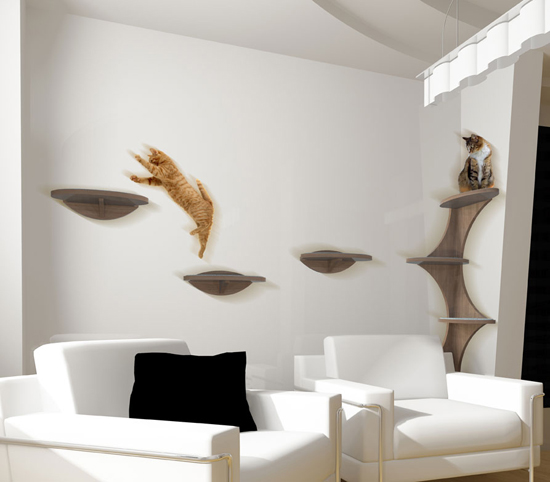
You can construct a series of perches and ramps inside the cat's room to make it more interesting.  Cat trees provide cats with different levels.  Moreover, cat furniture is often covered with carpet so they also serve as a scratching post. You can also provide cat shelves where cats can perch.  Here are some inspired and creative examples of enriching your cat's indoor environment without damaging your belongings:


This cat shelf design is discussed at http://www.home-designing.com/2009/03/spaces-for-pets-at-home


For more info on this DIY project go to:  http://www.moderncat.net/2008/08/17/diy-cat-shelves-for-a-modern-loft/


These projects can be inexpensive if you are handy with a power drill and leveler. You can get basic particle board shelving from the hardware store and carpet remnants are fairly inexpensive. 

So get creative and think of ways to keep your kitty entertained!


Los Angeles Dog Training:  www.pawsitivefeedback.com

Tuesday, June 5, 2012

Environmental enrichment for indoor cats


Indoor cats need exercise and mental stimulation

I have owned many cats in my life.  The ones who stayed indoors or stayed close to home died of old age and diseases associated with old age.  The ones who tended to roam often met with tragic ends earlier in life (hit by car, attacks by other animals etc).  So personally, I have opted to keep entirely indoor cats because of this experience and the last two cats (which includes a current one) live inside the house.

In fact, the American Veterinary Medical Association (AVMA) encourages veterinarians to educate their clients and the public about the dangers associated with allowing cats unlimited access to the outdoors. According to the AVMA:
Free-roaming cats may be exposed to injury, suffering, and death from vehicles; attacks from other animals; human cruelty; poisons; and traps. Additionally, these cats are more likely to be exposed to feline-specific and zoonotic diseases, and will prey on and can negatively impact native wildlife populations.
One of the challenges of having an indoor cat is making sure that they have enough physical exercise and mental stimulation.  Indoor cats are often sedentary and obese which are risk factors for diabetes.


There are many ways to enhance a cat's environment so that they do not become bored or inactive. My current tortoiseshell kitty needs lots of mental stimulation (Did I say lots?  I meant tons). Otherwise, she gets into all sorts of trouble in the house.   Since June is "adopt-a-cat" month, we will explore some ways to enrich your cat's life.  One thing that you can do is get rid of that food bowl and use interactive toys so that your cat has to "hunt" for her meal.  There are many interactive toys for cats on the market and even some dog toys work just as well for cats.  Here is a video showing how some of these food dispensers work:


Here are some links to the more common cat and dog toys that you can use for your cat:

Twist and Treat by Premier

In the video above, I used the small dog twist and treat.  There is a cat version as well but it is made out of slippery plastic instead of rubber.  I like the slightly larger dog version because it does not get under furniture so easily.  I also like the twist and treat shape better (regardless of whether it is the cat or dog version) because it does not roll under furniture as much as the round, ball type toys.


Slimcat

This is another food dispenser for cats.  This one has adjustable openings to accommodate different sized kibble.  Because of the shape it rolls around more which means more running around for your cat but it can also get lost under furniture.


Nina Ottosson Puzzles


These puzzles were designed for dogs but work just as well for cats.  They stimulate your cat's tendency to explore crevices and openings.  My cat loves these puzzles.


Kong Cat Wobbler

This is another toy I recently purchased for my cat although it was not featured in the video.  She also enjoys using this toy.  It does not move around as much as the other toys in terms of distance but it keeps the cat engaged and can help slow down eating.  Because my cat is used to puzzle toys, she figured out how to use this one fairly quickly.  As you can see from the video, I also use more than one toy at any given time so she does not get bored.


Have you used any interactive toys with your cat?  If so, which ones?  Next time we will talk about training your indoor cat as a way of increasing mental stimulation. 


Los Angeles Dog Trainer:  http://www.pawsitivefeedback.com

Friday, May 25, 2012

Are you Dog Savvy? Take the Bite Prevention Quiz


For the final installment of Dog Bite Prevention Week, I prepared a video presentation and quiz based on the previous 3 articles (click on the links below if you have not already read these articles): 
Ready?  Click on the link below to launch the presentation and quiz!

http://www.pawsitivefeedback.com/videos/dogbite/index.htm


Los Angeles Dog Trainer:  http://www.pawsitivefeedback.com/

Tuesday, May 22, 2012

Dog Bite Prevention: How to Greet a Dog


This week is Dog Bite Prevention Week and here are a few tips on greeting dogs.

Be on the Lookout for Stress Signals
In my last blog on Canine Body Language I went over some of the common postures and stress signals that dogs exhibit.  Here are a few signals to be on the look out for:
  • frequent yawning
  • licking lips
  • ears pulled back
  • pacing
  • panting.
 In a similar vein, learn a dog's aggressive stances.  This could include:
  • stiff body or very still body
  • ears forward
  • body leaning forward
  • hackles raised
  • tight/closed mouth
  • hard stare
  • Whites of eyes showing (also sign of stress)
  • curled lip
  • growling and snarling. 
Here is a video showing some common stress signals:


For Dog Owners:  If you have a dog that is shy, fearful or aggressive, here are a few tips to keep in mind if you see these signs in your dog:
  • Recognize and respect these signals and remove your dog from the situation that is causing stress by increasing the distance from the person or walking away.
  • Response to pushy strangers - Often you run into the person who tells you that they "know all about dogs," and try to approach your dog.  If your dog is known to be scared of stangers, tell the stranger that "my dog is in training and cannot be petted right now."   These are the type of people that will invade your dog's space and not respect the dog's signals. If they will not listen, walk away. Don't worry about offending a stranger. Your dog's well-being is more important. 
  • Give your dog a safe zone - if your dog is fearful in the home, it is important to tell guests to give your dog space, not to hover over the dog or stare at your dog.  If having guests over is too much, it is often better allow the dog to go his/her safe place, crate or behind a baby gate to minimize stress and the risk that a guest may disregard your instructions.
  • Guests in the home should not grab, hug, or forcibly try to move your dog off furniture.  Rubbing the belly can also trigger defensive behavior in a fearful dog who does not know or trust your visitor.  This is especially true for children who often like to try to hug unfamiliar dogs. If guests cannot follow these instructions, put your dog in another room or area.
  • Find a certified trainer - If your dog is frequently afraid of strangers, work with a dog trainer or behaviorist to develop a behavior modification program to help your dog feel more at ease around strangers.  It is important to choose a professional who focuses on positive reinforcement methods. 
For people greeting an unfamiliar dog:  if you meet someone else's dog exhibiting these signals when you approach them, stop and slowly back off to give the dog more space.  As a parent visiting someone's home, teach children not to grab or hug unfamiliar dogs.  If you see that the dog is showing stress in someone else's home, ask that the dog be placed in another room away from the children.


 Appropriate Greetings and Interactions
Besides being able to read a dog's body language or stress signals, another factor that can reduce the incidence of dog bites is knowing how to greet a dog in a manner that will put the dog at ease.  Here are a few tips:
1) Stop 5-6 feet in front of the dog and owner.  This is usually the distance that a dog is comfortable with and is also the length of most leashes if the dog is on a walk.
2)   Ask the owner if you can pet the dog.  If the owner hesitates or says the dog is not always friendly, move on.  If you are the owner and you notice that your dog is fearful or showing stress signals, ask the person to stop moving forward and refrain from reaching towards your dog.  For parents, stress this step to your children.  They should never pet a dog without asking permission.
3)  Turn your side to the dog  - dogs are often more comfortable when your side is facing them rather than facing them head on.   By turning your side to the dog, it makes them more comfortable to approach you.
4) Let the dog approach you - rather than going towards the dog and invading his/her space, let the dog choose to approach you and sniff the top of your closed hand.  If the dog does not want to approach you or shows you the stress signals mentioned above, then leave the dog be and do not try to pet the dog. 
5) Avoid Hovering and pet the side of the body or neck - avoid blind spots like the top of the head. Fearful/shy dogs do not like to be petted on top of the head and do not like people hovering directly over them.

Here is a video showing the steps:


It is also important for new puppy owners to make an effort to enroll their dogs in a puppy socialization class and socialize their dogs to as many different people as possible (gender, age, height etc). Through education of dog owners and dog greeters alike, hopefully we can help reduce the incidents of dog bites, interact with unfamiliar dogs appropriately and learn to recognize the signs of fear and discomfort in our dogs.

Los Angeles Dog Training:  www.pawsitivefeedback.com

Thursday, May 17, 2012

Harnesses, Martingales, Gentle Leaders, Oh My!

As a dog trainer, I feel compelled to try all the various no pull harnesses and collars on the market so that I can give an educated or (at least a first-hand opinion about how they compare). Owning two Akitas, I am fortunate enough to have dogs that are powerful and have a natural tendency to pull so they have been my guinea pigs so to speak. Here is the rundown and review of what harnesses I have tried and my personal opinion on the pros and cons of each:

Freedom Harness by Wiggles, Wags and Whiskers

This harness may be my favorite. I was introduced to this harness by Fabienne Lawrence at Bam Bam and Friends who carries this harness (I have not seen it anywhere else in Los Angeles). It is also a front-clipping harness like the easy walk but slightly different construction.


Here is Kiku wearing the Freedom Harness. The leash that comes with the harness makes it a versatile piece of equipment.

Pros: Works well on most dogs and cuts down on pulling. Like the Easy Walk, there is no breaking in period because the dog is more likely to accept this harness. The body strap is made out of velvet and softer than the Easy Walk. It comes with a lead that has a double clip and it can clip to D-rings in the front and on the back. The lead is adjustable from a 3-foot traffic lead to a 6-foot lead. The chest strap fits better than the Easy Walk (at least on my dogs).

Cons: pricier than the Easy Walk. Hard to find at pet stores (in Culver City at Bam Bam & Friends or online at Wags, Wiggles & Whiskers ).


Easy Walk Harness

Tis harness ranks high on my list of no-pull equipment.


Pros: Works well on most dogs and cuts down on pulling. No breaking in period as most dogs take to them readily, easy to use and effective on most dogs. It is easy to find at most pet stores and not that expensive.

Like the Freedom Harness, I use Easy Walks on some of the rescues I work with because of the ease of use and acceptance by the dog.

Cons: the chest strap does not fit well on dogs that do not have broad or protruding chest. In such cases, I clip the front d-ring to the neck collar with a carabiner to keep the front strap from dropping too low. The Freedom Harness tends to be a better fit with most dogs especially ones with narrow chests.


Here is Kiku wearing an Easy Walk harness which is attached to the neck collar with a carabiner to help hold it up.


Sporn Halter (with sheepskin covers)


Pros: cuts down on pulling surprisingly well (at least with my dog), no break-in period.

Cons: cumbersome to put on and take off, too many clips and moving parts (not good for furry dogs because hair can get caught), sheepskin covers slip and move too easily. Less control for reactive dogs.


Here is Kiku sporting a Sporn harness on a hike at Will Rogers State Park.

Sporn Simple Control Harness


Pros: Easier to put and take off than the Sporn halter, no break-in period.

Cons: Experienced more pull than with other harnesses.


Sporn Mesh Control Harness


Pros: Seems easier to put on and take off than the Sporn Halter. Decent job at reducing pull. No break-in period.

Cons: the mesh panel in the front did not fit well (on my dogs).

Gentle Leader

Gentle Leaders are not my first “go to” piece of equipment. But there are times when it may work better on certain dogs and for certain owners. I recently recommended a Gentle Leader for a client that had limited mobility due to a recent knee surgery and who had a very large dog. In this case, I felt the better control the Gentle Leader provided was warranted given the size of the dog and recent surgery. Sometimes, I also use this harness on a more reactive dog.


Pros: significantly cuts down on pulling, good control over the dog’s movements, a good option for reactive dogs or for people who are not that strong.

Cons: requires an adjustment period for many dogs, many dogs do not like the sensation of something over their mouth. People think the dog is wearing a muzzle and their fear of the dog will be expressed through body language and facial expressions.

However, one of the reasons, that I do not use the Gentle Leader very often, which is leading me to the “oh my” part of this piece is that, despite the fact that this product has been on the market for nearly two decades, people still mistake the nose loop for a muzzle. This causes people to recoil from the dog (especially when the dog is a large breed dog that has prick ears and looks like a wolf). When you see a golden retriever wearing a gentle leader that is one thing, but an Akita wearing a Gentle Leader causes people to side-step the poor dog and treat the dog like a pariah. For a young dog that needs to be socialized, this is not the reaction you want the dog to get from people the dog is trying to be friendly with. When my white Akita is wearing her Freedom harness, she receives smiles and requests from people to pet her. When she is wearing a GL, she receives sideways glances and people trying to avoid her. Because of this reaction, she rarely wears a GL because socialization is a high priority for this breed. So, there is a trade-off between control and managing reactivity and socialization with strangers.

Martingale collar

This is a nylon collar with a limited constriction on the neck. My Shiba Inu, who is an escape artist wears one. She does not pull so there is little pressure applied to her neck and I never jerk on her collar. This collar is better than a choke collar because the amount the collar tightens is limited and does not choke the dog if fitted properly. It is also good for dogs that have narrow heads like greyhounds or whippets.


Pros: prevents accidental slippage for dogs with narrow heads or who are escape artists.

Cons: does not necessarily cut down on pulling.

Choke chains/training collars/prong collars

Although I have used choke collars many years ago on dogs that have long since passed on, I don’t use them currently. Most people do not know how to use them properly and because of this, the risk of injury on the dog is too great. Moreover, dogs tend to pull more when pressure is applied to the neck, so I find the no-pull harnesses to be a safer and more effective way to discourage pulling. More importantly, why train dogs by putting pressure on their necks or choking them when you can use positive methods to teach them to walk on a leash. For these reasons, many trainers, including me, discourage the use of choke chains. See APDT UK's Brochure on choke collars here.


Los Angeles Dog Training
www.pawsitivefeedback.com

BlogCatalog